Across the United States, schools are increasingly restricting student cellphone use — and the policies are having measurable effects. A large national study on lockable phone pouch programs found that schools adopting structured phone storage saw a substantial reduction in in-school phone use, based on objective measures including device activity data and teacher reporting (NBER WP 35132, Allcott et al., 2026). Yet survey research consistently shows a significant gap between policy design and real-world implementation: educators report that enforcement is not always consistent across schools and classrooms, highlighting that a written policy alone is not enough.
That gap closes with physical infrastructure. Schools with lockable phone storage enforce their policies. Schools relying on compliance — bag rules, honor systems, verbal reminders — consistently do not. A dedicated phone lock box for schools is the infrastructure that bridges that gap.
A large number of U.S. states now have laws or guidance requiring schools to regulate student phone use during the school day. These rules differ significantly by state — ranging from full bell-to-bell restrictions to district-level policy requirements. No state mandates a specific product, but dedicated locking cabinets are among the most legally defensible storage options under current frameworks.
The legislative trajectory across the U.S. is steep and consistent. In 2023, Florida became one of the first states to pass a statewide phone restriction. By 2026, a large number of states had adopted some form of regulation — and states that started with classroom-only rules are steadily strengthening their approach, because partial restrictions proved difficult to enforce consistently in practice.
Key 2026 State Additions
Because state laws vary significantly in how “restriction” is defined — some mandate full bell-to-bell bans, others require districts to develop their own enforceable policies — no single figure fully captures the national picture. What is consistent across nearly all frameworks is one key phrase: “inaccessible location.”
Here is how each common storage method holds up against that standard:
What this means for your school: If your state has a phone restriction and students are currently storing devices in open pockets, bags, or caddies — your school’s compliance posture is worth reviewing, regardless of what your policy document says.
The evidence on phone bans is encouraging but nuanced. The landmark 2026 NBER study found that lockable phone storage substantially reduces in-school phone use, and that student well-being improves after the first year of consistent enforcement — though average test score effects are near zero. Survey research consistently shows teachers view phone distraction as a major concern. The research is clear on one point: enforcement only produces measurable results when paired with physical storage infrastructure.
The most comprehensive study to date is NBER Working Paper 35132 (Allcott, Baron, Dee, Duckworth, Gentzkow, and Jacob, April 2026). The study analyzed schools participating in lockable phone pouch programs using nationwide data combining large-scale surveys, GPS pings, standardized test scores, and school administrative records.
What the data confirms:
Additional evidence from Florida: NBER Working Paper 34388 (Figlio and Özek, October 2025) studied a large urban Florida district and found that in the second year after a phone ban, student test scores improved significantly and unexcused absences fell substantially — after an initial year-one spike in disciplinary incidents that dissipated as the policy normalized.
What teacher surveys show: Survey research consistently shows that a large majority of high school teachers report cellphone distraction negatively affects learning and classroom focus — though these findings reflect perceptions of distraction rather than direct measures of academic outcomes (EdWorkingPaper 25-1315, Figlio & Özek, 2025). With 88% of U.S. teens now owning smartphones, the phone is not an occasional distraction in most classrooms — it is a structural one. Physical storage removes that structural problem. Compliance-based policies do not.
The honest picture: Phone lock boxes are not a guaranteed test score booster. Early evidence on broader mental health effects remains inconclusive and requires more years of data (NBER WP 35181, Saffer, 2026). What the research does consistently show is that lockable storage is the enforcement approach that reliably reduces in-school phone use — and that well-being benefits emerge with time and consistency.
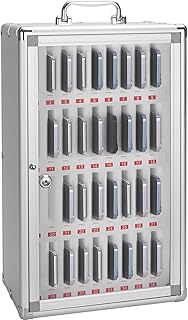
The mobile phone storage system with 36 slots serves as a protected yet efficient method for control of devices throughout classrooms and offices and public areas. This lockable organizer eliminates distractions and stops people from using phones improperly so it protects both security and organization. Schools, workplaces and public areas benefit from its durable construction which includes an acrylic door view through the individual slots. This cabinet provides dependable storage for devices while helping organizations implement phone policy enforcement so it serves as an excellent solution for all types of settings.
This 30-slot acrylic cell phone lock box acts as a protective system for the storage of phones together with wallets and small-sized valuables. Users can monitor their items through its transparent acrylic material, which has durability characteristics and security features built in. Users can use this lock box for office and classroom applications as well as event facilities thanks to its design which supports 30 customizable phone slots. Organizations can use this device because it locks securely to prevent unauthorized phone use thus serving as a tool for implementing strict no-phone regulations. Workers in classrooms, conferences and people in workplaces can use their 30-slot acrylic cell phone lock system to maintain both distraction-free and safe environments.
Students keep phones in bags or pockets during class. This approach relies entirely on student compliance and is the simplest to implement with no additional equipment required.
Best for: Low-restriction environments and trust-based policies where formal enforcement is minimal.
Phones are placed into numbered open slots at the front of the room. Teachers can see all devices at a glance, and the system is quick to set up and easy for students to use.
Best for: Classroom-only policies where visibility is the priority and student compliance is generally high.
Students seal their phone inside an individual pouch at the start of the day. The pouch stays with the student but cannot be opened until unlocked at a designated station at dismissal.
Best for: All-day phone restriction policies where students need to keep physical possession of their device throughout the school day.
Phones are secured in individually numbered, lockable compartments — accessible only to the teacher or at an authorized time. Enforcement is structural rather than dependent on ongoing staff monitoring.
Best for: Schools that want stronger device security, fewer classroom interruptions, and a more structured storage routine.
A lock box gives teachers a clear routine: phones are stored before class begins. This reduces the need for repeated reminders during lessons.
Phones can be expensive, and open storage can create theft or mix-up concerns. Individually locked compartments give each device a designated, secure space.
When phones are secured, teachers are less likely to deal with buzzing devices, social media use, messaging, or students checking notifications during class.
Students adjust more easily when phone storage becomes part of the daily routine. A consistent process can feel less like punishment and more like a normal classroom expectation.
Secure storage cannot solve every classroom issue, but it can reduce one major source of distraction. Schools may use it alongside clear policies, parent communication, and consistent staff procedures.
Steel cabinets are designed for daily use and can be installed near the classroom entrance. They usually include numbered compartments and a teacher-controlled lock.
Best for: Bell-to-bell policies, middle schools, high schools, and permanent classroom setups.
Clear acrylic units allow teachers to see stored devices quickly. They are useful when schools want visibility while still keeping phones organized and secured.
Best for: Elementary schools, classroom-only policies, and early policy rollouts.
Portable units can move between rooms and may include a carrying handle. They are useful for teachers who rotate classrooms or departments sharing one storage unit.
Best for: Shared classrooms, rotating teachers, and pilot programs.
Charging lock boxes include USB charging inside individual compartments. Students can retrieve their phones charged at the end of the day.
Best for: High schools, BYOD programs, long school days, and schools where battery concerns create resistance.
The most versatile high-security phone lock box in our lineup. Wall-mounted stainless steel construction with a built-in combination lock — built for classrooms, offices, factories, and labs that need reliable, tamper-resistant secure phone storage.
Available on Amazon · Ships with mounting hardware
For a typical class of 28–32 students, a 30- or 36-slot phone lock box is usually the most practical choice.
Schools and offices along with shared spaces can trust the 24-slot cell phone safety locker to provide durable phone storage that is secure. This stainless steel cabinet stands for prolonged service with its high-quality material while also protecting devices against harm and unauthorized entry. The safety lock within the cabinet maintains safety for stored devices while its handle provides convenience for movements. The cell phone safety locker functions as an organized protection system which protects multiple mobile devices within one secure compartment. The compact design and ample interior space of this product make it suitable for every area that needs controlled mobile storage management.
Exhibiting 36 stainless steel slots this locker functions to protect mobile devices in an organized manner. Businesses using this wall-mounted telephone storage cabinet can shield their mobile devices in classrooms, offices and industrial settings for increased security and resistance to tampering. The device comprises 36 distinct compartments that offer appropriate room to protect cell phones securely. Security levels are increased through the built-in combination lock which eliminates key-based access methods. The product features mounting on walls while taking minimal space which makes it simple to install and accessible to users. This cell phone storage container combined with the lock system functions as an effective security measure which brings focused productivity to educational, commercial and industrial workspaces.
The 30-slot steel cell phone storage cabinet functions as a security system with organizational features to store mobile devices in educational institutions and public and military establishments. The steel material construction provides extended durability which protects devices from potential harm. The cabinet’s transparent window enables watchful observation of stored phones regardless of the cabinet’s locked status to support security. The product operates with ease during installation since its lightweight allows both wall mounting and desk placement. The lockable phone storage system maintains a distraction-free space and serves as an excellent device policy enforcement tool for classrooms and workplaces in all professional settings.
The 30-slot cell phone storage station provides classrooms, offices and shared spaces with a secure system for organizing many mobile devices. The storage device allows for protected device storage through its thirty distinct compartments while offering no charging capacity. The tough construction along with a 5.5-inch slot system works for standard-sized smartphones. The storage unit functions perfectly to minimize distractions and keep students focused on work. This portable device design takes up little space which allows convenient installation in educational institutions as well as workplaces and public areas needing restricted phone access.
No. No state requires schools to buy a specific phone lock box. However, many schools are introducing stricter phone rules, and lockable storage can help make those rules easier to enforce.
They can reduce phone distractions and support a more focused classroom environment. Research on academic outcomes is mixed, so they should not be treated as a guaranteed way to improve test scores.
A lock box secures phones in locked compartments. An open caddy organizes phones in visible slots but does not prevent access. Caddies are useful for lighter classroom routines, while lock boxes offer stronger security.
Choose a unit based on your largest class size, plus a few extra slots. For a class of 28–32 students, a 30- or 36-slot unit is usually a good fit.
A phone lock box should include a teacher master key or quick-access system. Staff can retrieve devices if needed, while the school follows its established emergency communication procedures.
One email per week. New product reviews, buying guides, and practical tips for distraction-free environments. No spam, ever.
Join 3,200+ readers · Unsubscribe anytime