...
XStore theme eCommerce WordPress Themes XStore best wordpress themes WordPress WooCommerce Themes Premium WordPress Themes WooCommerce Themes WordPress Themes wordpress support forum Best WooCommerce Themes XStore WordPress Themes XStore Documentation eCommerce WordPress Themes
School Phone Ban: Challenges Schools Face & Smart Storage Solutions

School Phone Ban: Challenges Schools Face & Smart Storage Solutions

Facebook
Twitter
Pinterest
WhatsApp

Schools and offices are facing a challenge that has only grown in the past decade. Students and employees bring personal mobile devices into environments that demand focus, discipline, and security. Many institutions have turned to phone bans as a quick fix, hoping that restricting access will automatically improve attention and reduce distractions. Reality shows a different story. Bans alone rarely solve the underlying issues. Phones still appear in pockets and backpacks, conflicts arise over enforcement, and teachers or administrators find themselves caught between policy and practicality. Phone lock boxes offer a structured, operational solution, bridging the gap between intention and execution.

Why Schools Are Enforcing Phone Bans

A major motivator is academic performance. Research across numerous studies has shown that students allowed to have their phones out throughout class often exhibit shorter attention spans, are less focused on what the instructor is saying, and, from a classroom perspective, result in more fragmented learning outcomes. And phones aren’t just distractions; they also feature notifications, social media feeds, and messaging platforms that interrupt the learning process every few minutes.

Cyberbullying and the existence of inappropriate content make this more nuanced. Schools can’t control what students access off-campus, but they can limit exposure during the school day. “Phone bans, coupled with secure storage at school, reduce incidences of bullying and harassment or accidental exposure to harmful material.”

Classroom discipline suffers when devices are allowed freely. Teachers report spending significant time redirecting attention, asking students to put phones away, and resolving arguments sparked by messages or games. Even a few minutes of lost focus per class can accumulate into substantial learning loss over a semester.

Phone Bans Have Hidden Consequences

Policies that appear straightforward on paper encounter friction in reality. The rules are inconsistently enforced in classrooms and on campuses. Some teachers are strict rule followers Others make exceptions. Students quickly detect gaps and adjust behaviors to exploit inconsistencies.

Resistance from students is predictable. Phones are integral to social identity, communication, and personal organization. Mandating surrender without providing secure, trustworthy storage breeds conflict, passive resistance, and stress for both teachers and students.

Parents complain when devices are held or confiscated without a clear, secure system. Grievances, complaints, and requests for policy exceptions may arise due to concerns of emergency communications, loss, or damage.

Storage is the biggest operational issue. Without a functioning system, policy leaves phones in backpacks, on desks, or in unsecured bins. When there is no suitable infrastructure for management, misplacement, damage, and theft are common.

Operational Problems Schools Face Daily

A phone ban isn’t just a matter of rules. Administrators must determine where they are stored, who collects and stores them, and how they will be tracked Using a system or without System. For daily operations, everything is in disorder. Teachers waste time collecting phones at the beginning of class and handing them out again at the end. Lost or damaged devices prompt disputes. Theft or accidental drops in unsupervised bins create liability issues.

Time wasted in handling devices can add up. A 20-student classroom might spend 10 minutes at the start and end of each period managing phones. Across multiple periods and days, this translates into hours lost from actual instructional time.

Smart Storage Solutions That Work

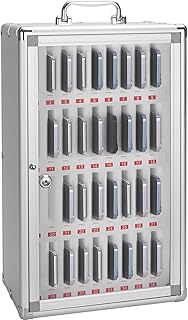
These operational gaps are covered with phone lock boxes. Purpose-built cabinets that provide secure storage for multiple devices in a single location while remaining accessible to authorized staff. In classroom-based systems, teachers can collect devices at the beginning of class and return them efficiently at the end. Centralized storage rooms are great for larger campuses or offices where a single point of accountability and security can be obtained.

Several design options exist. Cell phone lock boxes mounted to walls save floor space and cut clutter in classrooms. Free-standing multi-device cabinets hold larger groups or can be used multiple times during the day. Acrylic cell phone lockers allow visibility, so teachers can confirm contents without opening compartments; solid metal boxes provide the highest level of security for high-value devices.

How Phone Lock Boxes Support Policy Enforcement

Accountability is built into every well-designed lock box. Each device can have a labeled compartment or a numbered slot. Teachers no longer rely on memory or informal tracking. Students learn to follow procedures consistently.

Consistency reduces conflict. When every student deposits their phone in the same system, disputes over exceptions or missed deadlines decrease. Theft, misplacement, or accidental damage drops dramatically compared to ad hoc storage methods.

A structured phone locker also communicates seriousness about policy. Students recognize that rules are supported by infrastructure rather than arbitrary authority. This subtle reinforcement improves adherence without constant teacher intervention.

Our most popular products based on sales.

Our products most often added to Wishlist's.

Our best-selling new and future releases.

Most popular products as Most Gifted Products.

Storage Is the Crucial Missing Component

A phone ban without the necessary infrastructure will fail. We need a reliable, repeatable system to ensure accountability and enforce policy. Structured storage provides that system. That means institutions require solutions that are easy for teachers to adopt, clear to students, and defensible with parents. Better organization reduces friction, preserves devices, and emphasizes the point of not bringing tech into the classroom in the first place.

Real Implementation Example

A suburban high school implemented phone lock boxes in five 9th-grade classrooms. Before the phone ban, teachers spent 15 minutes per period gathering and returning phones. Students frequently resisted, stashing devices or squabbling over placement. Parents had complained about missing phones and liability issues.

Operations shifted after wall-mounted lock boxes with labeled compartments for each student were introduced. Collection time fell below 3 minutes. Teachers noted fewer distractions and increased instructional focus. Students quickly adapted, learning new routines and being responsible with devices. Parents said they felt more confident that the system was working, and that the school now had visible accountability measures in place. Maintenance needed occasional cleaning and sound of locks, but durability over the long term kept recurring costs low.

Expanding Use Cases

Phone lock boxes don’t just flag potential safety issues in the classroom. Devices can be securely stored during standardized testing to help prevent cheating or distractions. A mobile storage solution helps with school events, assemblies, or field trips.

Similar systems in offices protect employees’ phones in meeting rooms, labs, or other sensitive areas. Protects Intellectual Property — A conventional mobile phone locker provides you with complete peace of mind.

Comparing Phone Lock Box Types

Size and capacity matter. Small boxes can hold 12–24 devices, for perhaps a single classroom. Bigger cabinets are used to manage 50–100 devices for labs or locked storage.

Material differences influence longevity and security. Metal cabinets offer better theft resistance and fire protection, but may be heavier and more costly. Acrylic or polycarbonate lockers are lighter, more visible, and easier to install, but offer only moderate security.

Charging capability is a consideration. Some lock boxes include USB or power outlets, so devices can charge while stored. Multi-device systems generally require organizing the cords, while single-device compartments make that task much easier.

Cost versus value must be weighed. Basic acrylic boxes start under $200 for small classrooms. Metal, multi-device cabinets can exceed $800 but offer years of durable use. Schools with strict security concerns or high-value devices may justify the investment, while simpler solutions suffice for younger students or lower-risk environments.

Not all systems work in every setting. Schools without dedicated classroom space might be stymied by wall-mounted options. Lock rooms can offer advantages over classroom-based lockers for frequent office staff movement. Portable, free-standing units may be required for larger events rather than permanent installations.

Practical Buying Checklist

  • Monitoring daily device volume and peak usage times for the period.
  • Determine if the devices need to be charged while in storage.
  • Look for materials that provide security, stand the test of time, and require minimal maintenance.
  • Take size, number of compartments, and expandability into account.
  • Consider installation limitations such as wall or floor space.
  • Check lock type, user-friendliness, and procedures for determining replacement key or code.
  • Visibility vs. Security Needs — Planning for transparency without compromising protection
  • Consider cost versus expected lifespan and usage frequency.

FAQs

  • Do phone bans actually work in schools?

    They reduce distractions only when paired with structured storage. Without a system, compliance is inconsistent.

    What are the main obstacles to enforcing bans?

    The biggest obstacles include inconsistency, student resistance, parent worries, and a lack of secure storage.

    How do schools secure their phones for safe storage?

    Labelled compartments in a wall-mounted or free-standing phone lock box help to prevent theft, misplacement, and disputes.

    What is the least bad alternative to confiscation?

    Secure storage with clear procedures and accountability reduces the need for ad hoc confiscation.

    Can storage systems reduce student resistance?

    Yes. Students are more likely to observe rules and go along with phone bans if they know storage will be predictable, transparent, and convenient.

    Investing in a phone lock box system transforms policy from theory to practice. Schools and offices benefit from reduced distractions, increased accountability, and secure device management. The right solution aligns with operational realities, provides durability and security, and supports smooth daily routines without ongoing conflict. By evaluating capacity, material, and features against real-world needs, administrators can implement a system that works today and scales for tomorrow.