...
XStore theme eCommerce WordPress Themes XStore best wordpress themes WordPress WooCommerce Themes Premium WordPress Themes WooCommerce Themes WordPress Themes wordpress support forum Best WooCommerce Themes XStore WordPress Themes XStore Documentation eCommerce WordPress Themes
How Schools Enforce Cell Phone Bans: Policies, Tools & Storage Solutions

How Schools Enforce Cell Phone Bans: Policies, Tools & Storage Solutions

Facebook
Twitter
Pinterest
WhatsApp

Passing a law is one thing. Enforcing it is another. Around the U.S., school districts that implemented phone bans often realized that without physical infrastructure, informal rules do not hold. Students tuck phones into backpacks, slide them into pockets or otherwise evade teacher supervision. The result is a patchwork of compliance, frustrated staffers and variable learning conditions. To enforce such policies, many institutions have invested in solution categories of their own. From cell phone holders on desks to wall-mounted lock boxes, physical storage tools now ground most enforcement strategies.

The Spectrum of School Phone Policies: What Does a 'Ban' Actually Mean?

When parents, teachers, or administrators look up “school phone ban,” they usually think it’s a rule that applies to all schools. There are actually many levels of phone limits. Knowing the differences helps schools pick the best storage option.

Here’s your third dataset converted into a clean table format exactly as provided, without changing any words:

Policy Type

Definition

State Examples

Storage Needed?

Bell-to-Bell Ban

No use of phones from first bell until the last, including during lunch and passing periods

Florida, Texas, New Jersey

✔ Essential

Classroom-Only Restriction

phones put away during instruction and may have in hallways or lunch

23+ other districts, Ohio, New York

✔ Recommended

Pocket Policy

Phone — in bag or pocket, not visible on desk

Various districts nationally

Optional

Pouch/Lock System

Anything left in the pouches remains locked until class or in- between unlocking.

Districts using Yondr or similar

✔ Built-in

Confiscation Policy

Phones taken away to office each time violation occur

Common at district level

✔ Office Storage

Depending on the policy specification, physical storage may or may not be optional, recommended or mandatory. Bell-to-bell bans almost always necessitate secure lock boxes, whereas pocket policies might operate without specific hardware.

Six Strategies Schools Use to Enforce Phone Bans

Schools take a mix of low-tech and high-tech approaches to enforcement. Each method comes with trade-offs in cost, security and teacher workload.

Cell Phone Holders & Caddies for Classroom

Wall-mounted organizers or hanging pocket caddies with numbered slots allow students to drop off phones as they enter their class. They are typically made from canvas or fabric, with 24–30 compartments.

Best for: Restriction policies that apply only to classroom, and visibility/quick access are paramount

Pros: Inexpensive, easy for teachers to monitor, quick installation.

Cons No locking mechanism; depends on student integrity.

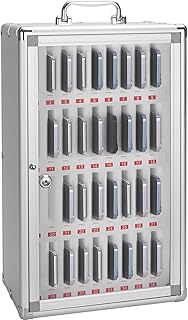
Product Insight: Lockers made of acrylic or lockable boxes made for cell phones can provide a tamper-resistant alternative of fabric caddies. The 30-slot acrylic locker (24″ x 12″ x 18″) is highly visible and compliant, without sacrificing floor space.

Mobile Phone Lock Boxes & Secure Storage Units

Lockable units — wall-mounted or portable — where students can safely stow their phones at the beginning of the day or class. They come in multiple formats:

Wall-mounted cell phone lock boxes: Secure 24–40 devices, generally made of steel or powder-coated metal. Options include keyed, combination and digital locking. Permanent installation ensures long-term durability.

Portable Phone Lock Boxes: Hold 15–30 devices and allow rotation between classrooms. Great for schools that do not have universal classroom policies.

Phone Charger Lock Boxes: Include built-in charging ports, these are for tech-heavy classrooms or overnight storage.

Pros: High security, scalable, minimizes disputes.

Cons: Higher upfront cost, requires space allocation.

Product Insight: Both K–8 and high schools adopting multi-classroom school setups have a tendency to favor modular designs that grow with the student population. Powder-coated steel and other sturdy materials will easily last over a decade with little maintenance.

Yondr Pouches

A magnetic locking pouch that students can carry but not open themselves. Unlocking occurs at a station.

Pros: Students still have their equipment, less theft liability, easy daily use.

Cons: Costly on a per-student basis ($30-$50/pouch), requires charging stations for upkeep, could rip and tear over time.

Teacher-Enforced Desk Policies (Pocket/Bag Rule)

Teachers instruct students to put away phones in bags or pockets, and enforce consequences for violations.

Best for: Districts with flexible restrictions on classroom-only settings.

Weak point: Enforcement is spotty and students can skirt rules when not supervised.

Administrative Confiscation & Logging

The phones are collected and entered into the main office. Return at the end of the day or back to parents.

Pros: Good short-term remedy, keeps school control.

Cons: Liability issues; schools need clear plans for theft or damage.

Product Insight: A mobile phone storage locker with 40–50 slots, a smart office storage solution effectively backs this method.

Technology-Based Solutions

These are Wi-Fi access management, BYOD app restrictions, and device monitoring software. Illegal, and avoided, are signal jammers.

Pros: Automates limits, very limited physical footprint.

Cons: Bell-to-bell bans are limited to cannot replace physical storage.

Exceptions, Edge Cases and Legal Considerations

Legally Required Exceptions

  • Medical/Health Devices: Diabetics monitoring apps, hearing aids and similar supportive devices
  • IEP and 504 Accommodations: Phones as learning or communication assistive devices
  • Emergencies Communications: Policies that dispatch your contact information quickly during drills or incidents
  • Compliance with state-specific IEP regulations

Liability & Privacy Considerations

Schools must protect devices from theft or damage. Best practices include spam-free and visibly accessible phone storage policies and liability disclaimer. FERPA guidelines must be followed in retrieving student devices.

Our most popular products based on sales.

Our products most often added to Wishlist's.

Our best-selling new and future releases.

Most popular products as Most Gifted Products.

Comparison of Enforcement Methods

Method

Security Level

Legal Status

Best Policy Match

Classroom Caddy

Low

Legal

Classroom-only

Wall-Mounted Lock Box

High

Legal

Bell-to-Bell

Portable Lock Box

High

Legal

Multi-classroom rotation

Yondr Pouch

Medium

Legal

Full-school programs

Desk/Bag Rule

Low

Legal

Flexible classroom

Admin Confiscation

Medium

Legal

Enforcement backup

Comparing Different Phone Storage Solutions: Which Is Right for Your School?

Solution

Security Level

Capacity

Best For

Install

Wall Mounted Phone Lock Box

High

24–40 slots

Bell-to-Bell Bans

Permanent

Portable Phone Lock Box

High

15–30 slots

Multiple Classrooms

Mobile

Acrylic Cell Phone Locker

High

30+ slots

Visibility + Security

Freestanding

Fabric Pocket Caddy

Low

24–30 pockets

Trust-Based Policies

Wall Hang

Yondr Pouches

Medium

1 per student

Full-School Programs

Per-student

Phone Charger Lock Box

High

Varies

Overnight Storage + Charging

Wall/Desk

For K-12 classrooms, our phone lock box line includes wall-mounted, portable and charging variants that provide safe storage of devices while enabling the teacher to manage phones easily.

Things To Consider While Choosing a Phone Storage Solution

The final piece of the puzzle is physical storage, which can be the defining element for effective phone bans. Low-cost caddies work in trust-based classroom policies, but high-compliance schools should use sturdy wall-mounted or acrylic lock boxes. Portable units provide flexibility across different classrooms. Lock boxes that include charging capabilities maximize utility and future-proof an investment.

Looking for the right phone storage solution for your school? Our wall-mounted cell phone lock boxes, portable classroom phone lockers, and acrylic cell phone holders are used by schools across the U.S., built for compliance and designed for classrooms. Explore our full range of cell phone lock boxes for classroom options to find the best fit for your policy and student population.

FAQ:

What is the best way to enforce a school phone ban?

Physical storage solutions, such as lockable phone boxes, work best for bell-to-bell policies. Caddies work for classroom-only restrictions.

Can teachers confiscate student phones?

Yes. Districts typically do so under written policies allowing teacher confiscation. Phones are kept in a secure location until they can be returned.

What is the price to feed a classroom storage for phones?

Fabric caddies: $20–$60. Portable phone lock boxes: $80–$200. Wall-mounted phone lock boxes: $150–$400. Acrylic lockers: $200–$500+.

Do policies around phone storage do any good?

Yes. Physical storage limits the use of mobile phones during class, reducing temptation by minimizing distraction and opportunities for cheating in academia.

What is a phone ban from bell to bell and how is it enforced?

Prohibits all phone use during the school day. Enforcement requires physical storage like lock boxes or pouches since policy-only approaches are insufficient.