At least 38 states and Washington D.C. now require school districts to ban or restrict student phone use during the school day (EdWeek, updated June 2026). New York secured $13.5 million in state funding for storage solutions as part of its FY2026 bell-to-bell restriction (Governor Hochul, NY FY2026 Budget). Kansas signed HB 2299 into law on March 19, 2026, requiring phones turned off and stored away from students from bell to bell, effective September 1, 2026 (Kansas Governor’s Office). New Jersey signed its bell-to-bell law on January 8, 2026, effective 2026–27, backed by a $3 million Phone-Free Schools Grant Program (NJ Governor Murphy, January 2026).
The laws are in place. The gap that remains is physical infrastructure and the phone lock box you choose determines whether your policy works in practice or collapses on day one.
A phone policy written on paper is only as strong as the physical system that enforces it. A large national study on lockable phone storage programs found that schools adopting dedicated storage systems saw a substantial reduction in in-school phone use — while schools relying on open pockets and fabric caddies saw minimal behavioral change (NBER Working Paper 35132, Allcott et al., April 2026, ~5,000 schools).
Here is how the most common storage approaches compare in practice:
Students keep phones in bags or pockets. Simple to implement, no equipment needed. Relies entirely on student compliance & enforcement depends on individual teachers staying vigilant across every transition, passing period, and lunch period throughout the day.
Best suited for: Trust-based environments with low-restriction policies.
Phones placed into numbered open slots at the front of the room. Visible to the teacher, quick to set up, easy for students to use. No locking mechanism phones are accessible to anyone in the room.
Best suited for: Classroom-only policies where visibility is the priority and behavioral compliance is generally high.
Students seal their phone in an individual pouch at the start of the day. The pouch stays with the student and cannot be opened until unlocked at a designated station. Effective when staff consistently enforce the morning routine.
Best suited for: All-day restriction policies where students need to retain physical possession of their device.
Phones secured in individually numbered, lockable compartments controlled by the teacher, accessible only at authorized times. Enforcement is structural rather than dependent on ongoing monitoring.
Best suited for: Bell-to-bell policies, high-compliance environments, and classrooms where teachers should not have to confront students to enforce the policy.
Browse our full range of phone lockers for schools and classrooms to compare options across all approaches.
Not sure which fits your policy? Browse our classroom phone cabinets filtered by material, slot count, and price.
Buy for your largest class, not your average. Running out of slots on day one teaches students the policy has exceptions — and they will push for theirs.
Always confirm slot dimensions before ordering. Standard slots should be at least 3.5″ wide × 6.5″ deep to fit current flagship smartphones. Students with thick protective cases may need wider slots.
| Policy Type | Recommended Storage |
| Bell-to-Bell Restriction | Locking cabinet — strongly recommended |
| Classroom-Only Restriction | Lockable locker — recommended |
| Pocket/Bag Policy | Open caddy — optional, trust-based only |
Our 30-slot charging station locker uses individual keyed slots with a teacher master key and includes built-in USB charging at each slot.
Standard lock boxes store phones. Charging units keep them powered. Most useful when:
Browse our full range of charging phone lock boxes for USB-equipped options with overcharge and short-circuit protection built in.
Three protected categories every teacher must plan for:
What your lock box must support operationally:
Your largest class period sets your minimum slot count. Running short on day one permanently breaks student trust in the system.
Slots measuring 3.35″ × 0.7″ (standard on many wooden units) are sized for standard smartphones without cases. Students using thick protective cases or wallet cases may not fit — confirm before ordering at scale.
The lock box belongs at the classroom door. Deposit happens as students enter — before they sit down. Placing it at the back of the room creates a detour that turns into a daily negotiation.
Who should NOT buy a standard 30–36 slot unit:
Each option below is matched to a specific classroom environment and policy type.
Wall-mounted thickened steel, individually numbered compartments, master key access. Fits most current smartphones including larger models. Available in 24, 30, and 36 slot configurations to match your roster size.
✔ Individually numbered compartments
✔ Rust-resistant steel — built for daily school use
✔ Teacher master key included
✔ Mounting hardware included
✔ Fits standard and large-format smartphones
33 numbered wooden slots, security lock, portable handle, wall-mountable or freestanding. Slot dimensions: 3.35″ × 0.7″ — fits standard smartphones without cases. Moves between classrooms without installation.
✔ 33 numbered slots with individual locks
✔ Portable handle — no installation required
✔ Wall-mount holes for optional permanent use
✔ Master key for immediate teacher access
10 clear acrylic compartments with individual key locks. Wall-mountable or desktop. Full visibility without unlocking. Purpose-sized for small groups, tutoring rooms, and pull-out sessions.
✔ Full transparency — confirm storage without unlocking
✔ Individual locks per slot
✔ Compact — no wasted capacity for small rosters
✔ Wall-mountable or desktop use
After evaluating units across schools, offices, and homes, these are the lock boxes that consistently deliver on capacity, security, durability, and daily usability. Each pick is matched to a specific environment and use case.
The most versatile high-security phone lock box in our lineup. Wall-mounted stainless steel construction with a built-in combination lock — built for classrooms, offices, factories, and labs that need reliable, tamper-resistant secure phone storage.
Available on Amazon · Ships with mounting hardware
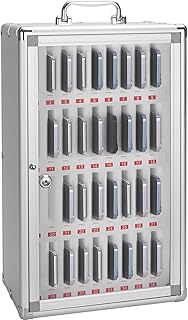
The mobile phone storage system with 36 slots serves as a protected yet efficient method for control of devices throughout classrooms and offices and public areas. This lockable organizer eliminates distractions and stops people from using phones improperly so it protects both security and organization. Schools, workplaces and public areas benefit from its durable construction which includes an acrylic door view through the individual slots. This cabinet provides dependable storage for devices while helping organizations implement phone policy enforcement so it serves as an excellent solution for all types of settings.
This 30-slot acrylic cell phone lock box acts as a protective system for the storage of phones together with wallets and small-sized valuables. Users can monitor their items through its transparent acrylic material, which has durability characteristics and security features built in. Users can use this lock box for office and classroom applications as well as event facilities thanks to its design which supports 30 customizable phone slots. Organizations can use this device because it locks securely to prevent unauthorized phone use thus serving as a tool for implementing strict no-phone regulations. Workers in classrooms, conferences and people in workplaces can use their 30-slot acrylic cell phone lock system to maintain both distraction-free and safe environments.
Rules vary by state and district. Some require phones to be stored away from students during the school day, while others let districts choose their own enforcement method. No state requires a specific phone lock box. See our state-by-state phone ban guide for details.
Yes. Students with documented medical, IEP, 504, or assistive-technology needs may need access to a phone or connected device. Schools should follow their district procedures and accommodation plans.
Schools should follow their established emergency communication plan. A lock box with a teacher master key or quick-access system allows staff to retrieve devices when needed.
Choose a unit based on your largest class size, plus 2–4 extra slots. For classes of 28–32 students, a 30- or 36-slot unit is usually a good fit.
It depends on the slot size. Check the product dimensions before ordering, especially if students use thick protective or wallet cases. Wider steel compartments are often a better choice for larger phones.
One email per week. New product reviews, buying guides, and practical tips for distraction-free environments. No spam, ever.
Join 3,200+ readers · Unsubscribe anytime