A member finishes a 45-minute workout, walks back to the locker room, and finds their phone gone. It happens more than gym owners admit. Over 115,000 mobile phones were stolen in London in 2023. Across the U.S., documented theft rings at LA Fitness, 24-Hour Fitness, and Lifetime Fitness locations have led to drained bank accounts and deliberately damaged phones. In one case, a thief observed a member enter their locker PIN, used it to open the compartment, and correctly guessed the same four digits were the victim’s bank card PIN.
Without dedicated phone storage, your gym is exposed to liability, member distrust, and reputation damage no marketing budget can fix.
Three vulnerabilities compound when a gym has no secure phone storage:
Each incident carries three layers of cost: financial loss to the member, reputational damage to your facility, and the churn risk when that member doesn’t return.
Phone theft at gyms targets the predictable 45–90 minute window members are separated from their belongings. Standard combination padlocks are predictable — and often share four digits with banking PINs. Dedicated phone locker systems with individual locks significantly reduce this exposure.
Industry numbers every gym owner should know:
Individual locking compartments sized for phones remove devices from the theft-target zone entirely. No single point of failure. Members who know their phone is genuinely locked away work out with more focus — improving the overall experience at your facility.
Providing designated, secure cell phone storage demonstrates a reasonable duty of care. It shifts the responsibility dynamic: you offered the secure option; the member chose whether to use it.
90% of members are likely to renew when a club is perceived as extremely clean and secure (IHRSA). A visible, well-maintained phone locker converts first-year members into long-term regulars — the single most profitable outcome a gym can achieve.
Phones off benches and machine edges mean less visual clutter, fewer hygiene concerns, and no member tension over filming. The result is a gym environment that photographs and presents as premium as your equipment investment deserves.
Fixed permanently near gym entrances or reception. Steel construction handles high daily usage, moisture, and commercial wear. Most units hold 24–40 phones with combination or keyed locking.
Best for: Large gyms, fitness chains, high-traffic facilities. Pros: Highest security, tamper-resistant, space-efficient. Cons: Requires wall mounting; fixed after installation.
Clear construction gives members instant visual confirmation their device is secure — no “is it still there?” anxiety. Staff can sweep the entire unit visually in seconds.
Best for: Boutique studios, yoga and Pilates spaces, smaller gyms where visible trust matters. Pros: Full transparency, compact footprint, repositionable. Cons: Less impact-resistant than steel under heavy sustained use.
Mobile units holding 15–30 devices move between locations — front desk during peak hours, near the weight floor for classes, stored during off-hours.
Best for: CrossFit boxes, boutique studios, multi-room facilities. Pros: No installation, completely flexible placement. Cons: Lower security than wall-mounted if not anchored during use.
Individual key locks in warm wood finishes for premium aesthetics. Available in 24–36 slot configurations with individual keys and staff master lock access.
Best for: Premium health clubs, hotel fitness centers, spa-adjacent studios. Pros: Premium appearance, durable in dry environments. Cons: Not suitable for high-humidity zones near showers.
Built-in charging ports inside each compartment remove the most common member objection: “I need it charging.” These function as a genuine amenity, not just a restriction.
Best for: Tech-forward gyms, corporate wellness facilities, commuter-heavy urban locations. Pros: Eliminates adoption friction, doubles as member perk. Cons: Higher upfront cost; requires proximity to a power outlet.
Editor’s Pick for Most Gyms
Choosing the right type: Evaluate peak member volume (determines slot count), placement location (entrance beats locker room every time), lock mechanism, material durability for your humidity level, and whether charging capability will drive adoption among your specific membership.
Quick Answer: Setup takes less than a day. Choose your type, position near the entrance, brief your front desk team, communicate the launch to members, and review usage at 30 days
Ask front desk staff how often members report lost or stolen devices. This baseline confirms what you’re solving and where.
Count average peak-hour concurrent members. Divide by two as a conservative adoption estimate for launch. That number is your minimum starting slot count.
High-traffic permanent facility → wall-mounted steel.
Boutique or visibility-first → acrylic.
Multi-use flexible facility → portable.
Premium or hotel gym → wooden cabinet.
Urban commuter gym → charging-capable unit.
Front desk area or just inside the main doors — before members reach the locker room. Never inside the locker room. Secondary placement near the weight floor entrance for larger facilities.
One laminated card: “Store your phone before your workout. Collect your key at check-out. Lost your key? See the front desk.” Complex policies reduce adoption.Individual locking compartments sized for phones remove devices from the theft-target zone entirely. No single point of failure. Members who know their phone is genuinely locked away work out with more focus — improving the overall experience at your facility.
Staff should mention the locker on every new member tour for the first month. Send one email, post one photo on Instagram, place one sign at reception. Frame it as a member benefit, not a rule. Review usage and capacity for 30 days.
The highest-security gym phone locker in our lineup. Wall-mounted stainless steel with a built-in combination lock and 36 individually numbered compartments. Rust-resistant frame, no keys to manage, installation hardware included. Built for high-traffic commercial environments that need tamper-resistant phone storage built to last years of daily use.
✔ 36 individually numbered compartments
✔ Rust-resistant stainless steel frame
✔ Built-in combination lock — no keys to lose
✔ Includes mounting hardware
→ Shop the 36-Slot Wall-Mount Locker at $88.00
Clear acrylic construction with front and rear door access — ideal for reception desks where staff need access from both sides. 30 individually locked compartments. Visibility builds trust that steel cannot match, making adoption faster in boutique environments.
✔ Full clear visibility across all 30 compartments
✔ Front and rear door access for staff efficiency
✔ Compact footprint fits any reception desk
→ Shop the Dual Access Acrylic Locker at $349.99
Hybrid acrylic-and-wood construction with 30 slots, 60 keys, and individual door locks. Compact at 20″L × 7.4″W × 13.3″H — fits any wall without consuming floor space.
✔ 30 slots with individual key locks
✔ 60 keys included (2 per slot)
✔ Acrylic panels + wood frame for premium appearance
→ Shop from $70.00
After evaluating units across schools, offices, and homes, these are the lock boxes that consistently deliver on capacity, security, durability, and daily usability. Each pick is matched to a specific environment and use case.
The most versatile high-security phone lock box in our lineup. Wall-mounted stainless steel construction with a built-in combination lock — built for classrooms, offices, factories, and labs that need reliable, tamper-resistant secure phone storage.
Available on Amazon · Ships with mounting hardware
The mobile phone storage system with 36 slots serves as a protected yet efficient method for control of devices throughout classrooms and offices and public areas. This lockable organizer eliminates distractions and stops people from using phones improperly so it protects both security and organization. Schools, workplaces and public areas benefit from its durable construction which includes an acrylic door view through the individual slots. This cabinet provides dependable storage for devices while helping organizations implement phone policy enforcement so it serves as an excellent solution for all types of settings.
This 30-slot acrylic cell phone lock box acts as a protective system for the storage of phones together with wallets and small-sized valuables. Users can monitor their items through its transparent acrylic material, which has durability characteristics and security features built in. Users can use this lock box for office and classroom applications as well as event facilities thanks to its design which supports 30 customizable phone slots. Organizations can use this device because it locks securely to prevent unauthorized phone use thus serving as a tool for implementing strict no-phone regulations. Workers in classrooms, conferences and people in workplaces can use their 30-slot acrylic cell phone lock system to maintain both distraction-free and safe environments.
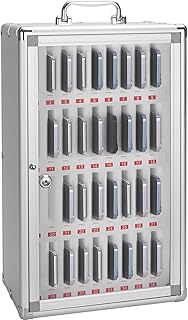
A set of compact, individually locked storage compartments designed specifically to secure member smartphones during workouts. Unlike standard gym lockers, they are sized for devices, positioned at high-visibility entry points, and built for high daily commercial usage cycles.
Adoption depends almost entirely on awareness and placement. When lockers are positioned visibly near the entrance and mentioned during onboarding, usage builds consistently. Members who experience or hear about a theft incident become the system’s most reliable users from that point on.
For most gyms, a wall-mounted steel unit with 24–40 slots is the best default — highest security, handles heavy daily use, minimal ongoing management. Boutique studios typically prefer acrylic for transparency. Facilities needing flexibility should choose portable units.
Target 40–60% of your peak concurrent members count as your starting capacity. A gym with 50 peak-hour members should start with a 24–30 slot unit and scale as adoption grows.
Most membership agreements disclaim liability for personal property. However, offering dedicated secure phone storage demonstrates reasonable duty of care — which significantly reduces both legal exposure and the reputational damage of theft incidents at your facility.
One email per week. New product reviews, buying guides, and practical tips for distraction-free environments. No spam, ever.
Join 3,200+ readers · Unsubscribe anytime